
How We Use Jockey Form

Why the rider matters, when jockey form can make the difference, and why it should support the case rather than create it

Why Jockey Form Matters

Jockey form is one of the most useful supporting factors in racing analysis, particularly in competitive races where small details can make a big difference.

A rider in good form is often making better decisions, judging pace more sharply and getting horses into stronger positions at the right time. Confidence matters in racing, just as it does in any other sport.

That said, jockey form should never be looked at in isolation.

In very much the same way that we treat trainer form, at Turf Talk, we treat it as a supporting factor within the wider ratings model. The horse still has to fit the race, the trip, the ground and the overall profile. A good jockey can help deliver a horse’s chance, but cannot turn the wrong horse into the right bet.

Used properly, jockey form can strengthen a case and help separate closely matched runners. Used badly, it can tempt punters into overvaluing a rider’s reputation rather than the race in front of them.
What We Look For

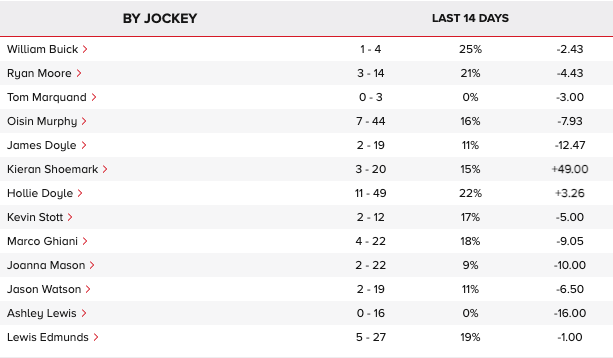
  • Recent 14 day form
  • Big race confidence and decision making
  • Course knowledge and track record
  • How well the rider suits the horse
  • Whether the jockey is likely to improve the horse’s chance

What We Avoid

  • Backing a horse just because a top jockey is booked
  • Ignoring the actual profile of the runner
  • Overrating reputation over current evidence
  • Assuming every jockey booking is a major clue
  • Letting one rider angle override value

How Turf Talk Uses It

  • As a supporting layer in the ratings
  • To help split shortlists in tight races
  • To reinforce or weaken confidence in a runner
  • To assess whether a horse is likely to get the right ride
  • To strengthen the overall race profile

Why The Right Ride Matters

Not every jockey brings the same strengths to the same race.

Some riders are particularly strong from the front. Some are patient and excel at delivering a late challenge. Some are excellent around certain tracks. Others are especially strong in big field handicaps where positioning and timing matter enormously.

That is why we are not just interested in whether a jockey is in form. We are also interested in whether the rider fits the race.

For example:

  • does the horse need a cool, waiting ride?
  • does it need to be positive and hold a position?
  • is the rider strong in a finish?
  • is this the sort of race where experience and composure matter more than usual?

Those details can be crucial in major handicaps, festival races and strongly run contests where a poor tactical decision can cost a horse several lengths.

Jockey Form

When Jockey Form Is Most Useful

Jockey form tends to matter most when:

  • the race is tactical or likely to require a well judged ride
  • the field is large and positioning will be important
  • there are fences or hurdles where rhythm matters
  • the horse is not straightforward and needs the right handling
  • the contest is close enough that small edges matter

In those races, the right jockey can make a very real difference.

When We Keep It In Perspective

Jockey form matters less when:

  • the horse looks badly treated or poorly suited by conditions
  • the price has shortened too far because of the booking
  • the horse is simply not good enough for the race
  • the field lacks depth and the class angle is obvious

A top jockey is a positive, but not a magic wand. The horse must still bring the right form and the right profile.

The Turf Talk View

Jockey form is a key supporting part of the Turf Talk ratings, especially in major races where racecraft, positioning and judgement matter.

We look at who is riding well, who is likely to suit the horse and whether the booking strengthens the overall case.

But the key word is strengthens.

We do not want the jockey angle to become the entire reason for a bet. It should help confirm a horse’s chance, not invent one.

That is why the Turf Talk method always keeps the main focus on:

  • the horse’s suitability to the race
  • its current form and profile
  • the conditions
  • the value in the price

Once those boxes are ticked, jockey form can become a very useful extra piece of the puzzle.

That balance is exactly why it remains an important but controlled part of the Turf Talk ratings model.

The Best Jockey Booking In The World Still Needs The Right Horse In The Right Race